

Loch Katrine Cruise
Updated: Jan 26
As part of my mum's 80th-birthday celebrations, we booked a steamship cruise along Loch Katrine in the Trossachs - an area of wooded hills and large bodies of fresh water. Nicole and I accompanied her on a chilly but sunny late-autumn afternoon. We paused for lunch in Callander - a Highland gateway town. The road out to Loch Katrine took us by Loch Venachar, through the picturesque Brig O' Turk village and past the grand Loch Achray Hotel. Loch Lomond & The Trossachs National Park was established in 2002 and features 21 Munro peaks. The Highland Boundary Fault runs right through the territory.
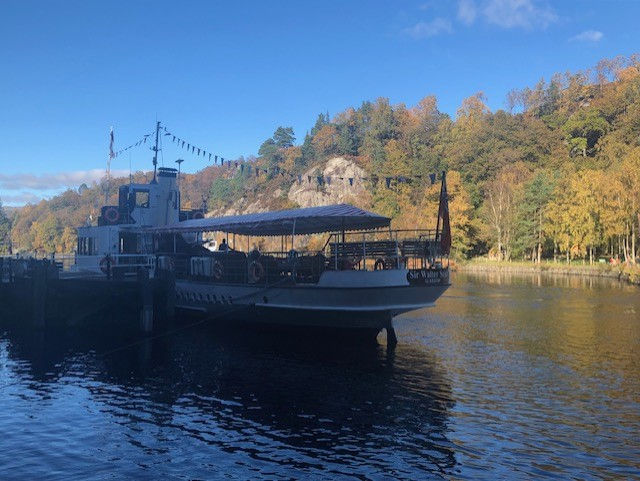
We waited on the pier as Sir Walter Scott was being prepared for departure. The 111-foot vessel was built on the banks of the River Clyde at Dumbarton. The next challenge was to transport the ship to the landlocked loch where she would ply her trade (replacing Rob Roy II). In sections, the boat was taken by barge up the River Leven, then on to the mighty Loch Lomond. Docking at Inversnaid, horse-drawn wagons were employed to lug the separate pieces overland to Stronachlachar, for reassembly on the shore of Loch Katrine. After a major refit in 2009, Sir Walter Scott is now licensed to carry 245 passengers. The craft is named after the legendary Scottish writer, whose works helped promote the captivating Highland landscapes and encouraged Victorian tourists to visit areas such as the Trossachs. Scott's famous poem Lady of the Lake was apparently inspired by his travels around the region. The railway reached Callander in 1858 and steam travel on Loch Katrine also dates from this era. We had booked a 2-hour cruise that would take us along to Stronachlachar and back. A 12-mile trip in total. Full commentary was provided throughout and a fully-stocked bar was available on board. It was a beautiful day and we sat out on deck, watching the countryside roll by at a leisurely pace in this remote corner of Perthshire. It was also possible to peer through am open flap and watch the steam engines work tirelessly. Loch Katrine sits within a glacial valley and functions as the main water reservoir for Glasgow. The deepest point is 154 metres and many streams feed in from the surrounding hills. Cities expanded rapidly during the 19th century and Glasgow's water supply infrastructure struggled to cope. A major cholera outbreak in 1847 prompted the authorities to seek a new source. A series of aqueducts and tunnels were constructed to convey the precious resource and the scheme was complete by 1859 - opened by Queen Victoria and costing a million pounds. The east end of the loch was dammed and its level raised by over a metre. Glasgow became known as the Second City of the Empire and the health of its citizens was transformed by the new water supply. The boat eventually reached the far end of the loch and docked at the hamlet of Stronachlachar, which has a café by the pier A number of people boarded, including several cyclists. A network of trails runs through the national park and Loch Lomond is only four miles distant from Stronachlachar as the crow flies. Bikes can be rented from Trossachs Pier.

As we turned around for the return leg, the white-painted Glengyle House was clearly visible on the shore at the extreme western point of the loch. The 18th-century three-storey dwelling was built on the site of a stone cottage where famous outlaw Rob Roy McGregor was allegedly born in 1671. The house had been in the hands of various water authorities since the 1930s but was released to the private market in 2004. A cattleman by trade, Rob Roy - like many clansmen - became caught up in the Jacobite cause. The politics of the time were complex and double dealing was rife. Many shifted their perspective as and when it suited their personal circumstances. Yet the movies would have you believe all belligerents had nailed their colours irretrievably to a particular mast and were guided solely by heart. Fictionalised accounts of Rob Roy's life have established him as a Highland folk hero and indeed the whole Jacobite affair was romanticised in books, poems and paintings years after the actual events took place. The clan tartans were largely Victorian inventions and it is now virtually impossible to distinguish myth from reality. But a good yarn brings in business. We chugged back to the starting point and the sun continued to shine. The cruise is worth taking for the scenery alone. You can also combine your sailings with walks at either end.


Comments